Showing posts with label Firewall Forward. Show all posts

Thursday, October 15, 2015

47-07 prop pitch revisited

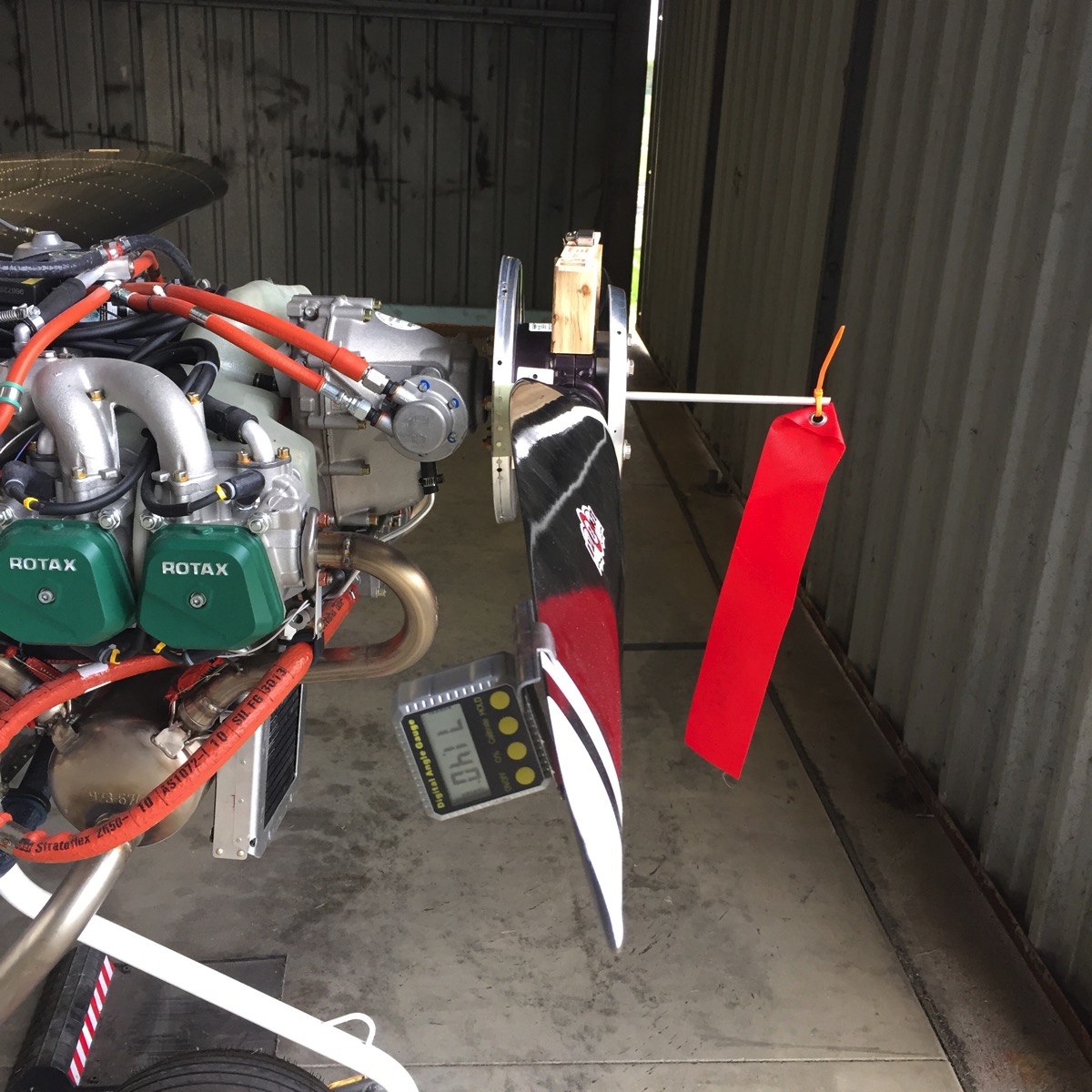
VAF has many posts regarding the setting of the pitch of the Sensenich prop.  The tool that is provided by Sensenich is really not very precise.  They provided a wooden template that is supposed to help create an accurate surface upon which to measure blade angle, but it’s also not too precise.  Last week, Van’s released an update to The Book that uses a steel tool to hang on the edge of the blade and allows a magnetic level to be used to set a specific angle (71.4°) relative to the canopy deck.  It’s very hard to see in this photo, but the prop is leveled using some wooden blocks (custom cut to an arbitrary but equal height), a paint stir stick, and a socket (from a socket set.)   I didn’t have a bubble level at the hanger and I realized that I really couldn’t use the digital level since it can be zeroed and thus does not have an absolute way to establish level.  I used the cylindrical socket on top of the stir stick:  when it didn’t tend to roll one way or the other, the prop blades were level!

With that task completed, I closed the shop and went to work.  Next step:  Airworthiness Inspection on 10/19!


IMG 4719

Prop blades pitched to 71.4°

Saturday, May 23, 2015

Valve Lifter Check—Passed

I don’t like Rotax’s documentation.  It’s extremely detailed to the point of nearly being unreadable.  I also haven’t found anything that remotely resembles an index, so it’s impossible for me to navigate the plethora of pages to find the minutia of importance.  Case in point.  I recall reading that after 1st start, you must remove the valve covers and verify that the lifters don’t move with 15 # of pressure when the valves are both closed at TDC for each cylinder.  This blog entry is to document that I have performed that procedure, but I can’t find the document to cite it properly.  I’ll amend this posting when I find that document.

partial sync

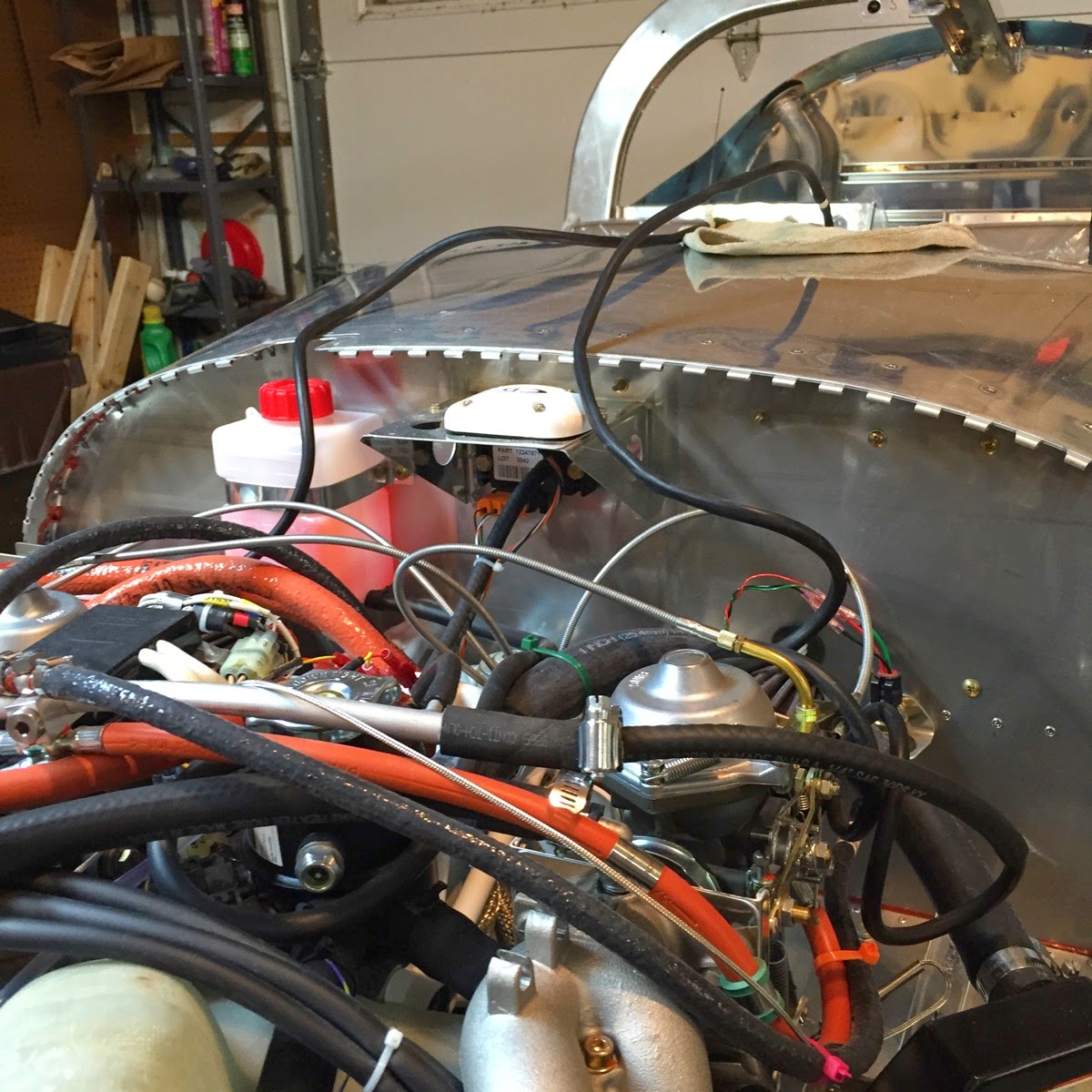
The photo shows a motorcycle carb sync gauge looped into the cockpit.  I spent several hours with multiple sized hoses and clamps jury-rigging the plumbing to get from the compensator tube and Left carb.  When I finally got it out and started the next day, I had clamped down so tight at two places that the gauges were totally isolated from the vacuum.  Frustrating but funny, in a geeky sort of way.

I got the engine started again, and did a partial sync of the carbs.  I know that it’s within my capabilities, but I’m not at all confident of how to synchronize them from both idle and moderate / high power.  I can hear the transmission knocking at low power and that’s not good, so I’m going to defer final synchronizing to Shane when I move out to KDLZ.


IMG 4320

Carb Vacuum Gauges in place

46-07 #9, #10 Install Prop & Spinner


I naively thought this would be a slam dunk.  Not!  I spent nearly 4 days fighting with the little tiny gap fillers that aren’t even visible in the photo.  The downside of my initial sanding to fit was that I really failed to appreciate the fact that the roots of the prop blades are truly elliptical and I did my initial fitting to the minor axis of the ellipse.  When I figured out how to pitch the props, they axis is quite different and they rotated up and impinged on the gap fillers.  I had to find assistants to remove & re-install the blades several times to get things sanded down to fit. 


IMG 4332

IMG 4333

Prop Pitch Measurement Tool

 I also made an assumption that turned out to be false: that the leading edge pitch of the descending blade was the negative of the pitch of the ascending blade.  The question of the assumption was triggered by a thread on VAF.  I had previously set the prop pitches as 22.6° and -22.6° using the canopy side rail as the 0° reference.  Last night I finally realized that this assumes the prop axis of rotation is parallel to the canopy rail.  There’s no way to easily check that, but I’m pretty sure that they are not parallel because when I checked both blades in the ascending position, I found there was about 4° variation.  I gave up on using the digital method for now and set both blades using the #3 pin.  I’ll revisit this after I get the carbs synched.


IMG 4325

Prop & Spinner installed.  Finally.


Wednesday, May 20, 2015

47-06 (less #9, #10) spinner final steps

The holes for the nut plates were final drilled #19, then the wing holes got drilled (from the inside).  Lots of countersinking and deburring, then lots of riveting.  You can see through the translucent fiberglass the two metal plates used to hold the gap fillers in place.  That metal is only 0.032” but The Book called for countersinking.  I declined and dimpled instead.  I know, I’m a rebel.

The plate off to the side is the optional spacer I used to help alleviate the cowling spacing issue described else where (and nearly remediated, I might add!)   I wasn’t able to do the final prop & spinner install because I need AN5-16 bolts (instead of AN5-15’s) due to that spinner.  That, and it’s 1:00 AM when I took that picture and I didn’t have an assistant to hold the prop blades in place.  BTW, the bolts arrived this morning about 10 hours after I took this picture.  Stay tuned.


IMG 4276

47-05 Spinner fitting

Quite a number of clecos!  There are 4 on the forward (internal) bulkhead and 10 around the perimeter of the main spinner plate.  Then there are 4 more on each side of the filler plate. 

IMG 4274

Spinner clecoed into position

47-04 Spinner Alignment

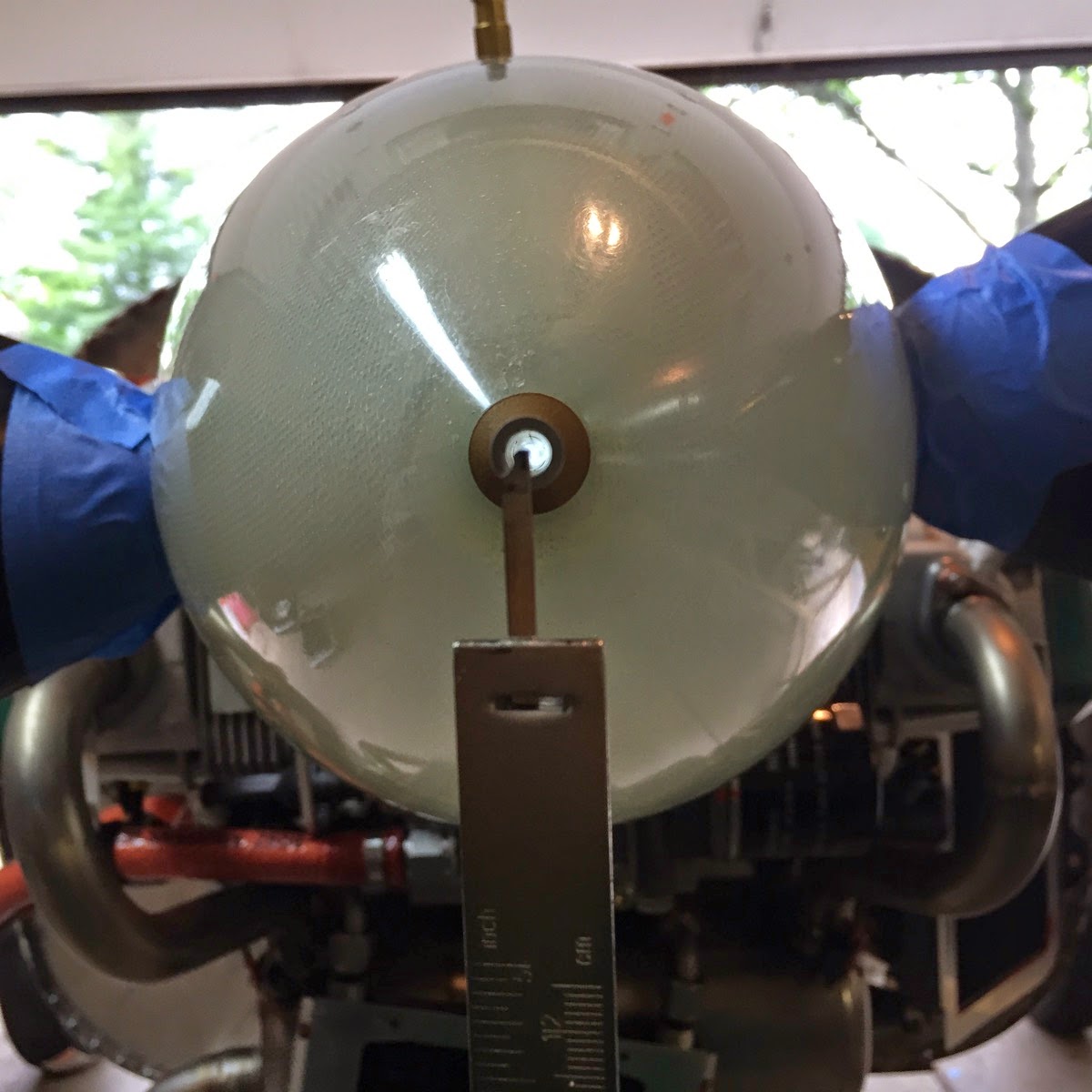
 This page is all about getting the spinner well aligned.  Take out the plugs so you can rotate the engine, tape up the prop blades to prevent scratches and clamp the spinner to the back plate.  Then turn the prop and verify that the pitot tube doesn’t wobble (thus indicating that the spinner is well positioned.  The Book recommends taping a ruler to a chair to position it right in front of the pitot tube so you have a good visual reference.  I couldn’t get the ruler taped juuuust right, so I used my micrometer so I could adjust the tip.   

For the photo, I put a light source on the (clear) pitot tubing behind the gearbox and it very nicely illuminates the inside of the metal pitot tube. Nice!


IMG 4239

aligned spinner

Saturday, May 16, 2015

47-03 Spinner Prep

Lots of fiberglass cutting today.  The spinner had a 1” lip that needed to be trimmed off as well as the cutouts for the prop blades.  I used the cutting wheel for the posterior lip, since that will be fine sanded to the backing plate in the near future.  I hand-cut the side cutouts using a fine tooth hack saw blade.  The upper rounded portion was easier, since it didn’t have to be preserved.  (Note the fiberglass piece in front of the spinner—that will become the side panel behind the prop blade.  It needed to be cut with minimal loss of material, so I used the finest blade I could find.)  The upper part came out with some holes drilled near the perimeter, then quickly ground to shape with the Dremel tool with a  sanding drum.

There’s a small bushing (brown) that goes in the tip.  That needed to be roughed up and placed in the hole, after the hole was ever-so-slightly enlarged.  It’s glued in with blue Loctite.

The rest of this page is the installation of the propeller, but I already did that last month as part of the engine startup, so I can officially take credit for this page today.


IMG 4238

Spinner 

Friday, May 15, 2015

47-02 Pitot Tube

I’m baaaaack!

I’ve been away from posting on this blog for nearly 3 weeks.  As you’ll recall from 4/4, I found a problem with the fit of the cowlings against the spinner plate. There was no easy fix, but so far, it appears that there’s a cheap fix.  I reached the point where I’m reassured that I’ll be able to finish the revision without having to buy new cowlings, and will post a separate update when all is complete.  Having reached that point, I felt ready to resume forward progress.


This photo shows the pitot tube.  Recall that the RV-12 is designed with removable wings, and Van’s didn’t feel that it was feasible to make a detachable pitot line that runs back to the ADARHS in the tail cone.  They designed the pitot tube that goes through the engine gearbox, prop hub and out the tip of the spinner.  On the left of the transmission you can see the white plastic box that the pitot tube is attached to.  To its left is the clear plastic tube that goes back to the ADARHS.  Out of the right of the prop hub is the looooong metal pitot tube itself.  I want to get the spinner attached this weekend to protect that thing from getting bumped by some clumsy oaf (that’d be me).  


IMG 4236

Pitot Tube


Friday, April 17, 2015

First Start!

Big Day!  Finally got the electronics on-line and the engine started!

After meeting with Brent (EAA Tech Counselor), my next expert resource is Shane, the A&P who owns/operates the shop at KDLZ.  He’s pretty comfortable with Rotax engines and is listed as a Rotax Mechanic by their website.  I’ve known Shane for about 8 years and called him up for a favor of looking everything over before I put my engine to the test. I had to work fast to get things ready for his arrival, since our mutual schedules didn’t work out that well and we only had one day in April that worked for both of us.  (That came to bite me later, as I found out that I wasn’t as ready as I thought I was.)  Anyway,  he was game and spent a Saturday afternoon with me.  Like Brent, he was pretty pleased with what he saw.  I learned a bunch of little tips that were really one of the reasons I invited him over.  After we were done inspecting everything, it was time to try to get to work. Unfortunately, it didn’t work out that particular day.  (Bummer for Shane.)


IMG 4184

First Power to Avionics

The picture above shows the Skyview computer powered up for the first time.  The center panel is OK and correctly identifies our location (GPS is working).  The right panel is X’ed out because the ADAHRS isn’t even attached (it’s in the tail cone.)  The unpleasant surprise is the left panel, which is supposed to be showing me the engine gauges.  The help message isn’t particularly helpful at this stage: ‘Please review the “Getting Started” section of the installation guide.”    Shane & I reluctantly decided to quit here since there was no way I was going to start the engine w/o some gauges.

 That night, I finally found the page I needed in the installation guide and was able to do the configuration needed to get the electronics to recognize each other.

IMG 4185

Skyview with Engine Monitor & ADAHRS

This is a much nicer thing to see.  The engine monitor is on the left and shows what you would expect for a non-running engine.  (I found the loose wire for the R EGT.)

The next step was to get the engine oiled properly.  I tried hand turning the prop as suggested by Shane and even did a no-plug quick spin of the engine with the starter, but no pressure.  Back to the books.  The Rotax manual is even less inviting and readable than the Skyview.  I eventually found the page that directed me to remove the engine-to-tank hose and pressurize the oil reservoir while hand turning the prop until oil pressure registered.  Stacey held fingers on the appropriate outlets, Nick watched the oil pressure gauge and I hand turned the prop, but no joy.  The next day I found an oil puddle under the radiator.  Initially, that was bad news.  Then I thought about it and realized that it meant I had been successful in getting oil through the system.  I tightened up the errant connection.

I brought the plane out into the driveway and facing into the cul-de-sac.  One quick spin w/o plugs and oil pressure promptly climbed to about 45 psi.  Now we’re cookin’!   Spark plugs got installed and I tried to start it 3 times before realizing that this isn’t a Cessna.  In every other plane I’ve flown, the key switch is designed so that you have both mags enabled before you can get to the Start position.  Not so here.  I ground the starter 3 times before I realized that I hadn’t turned on the Ignition A and Ignition B switches.  (Note to self:  use your checklists!).

With that little bit of understanding, I made one more attempt at starting and....  Viola!   As you can see on the link, the engine started immediately and ran great.  I ran it a total of 3 min or so.  EGT’s, then oil, then CHT’s started to register as I played with throttle & choke a bit.  As an experiment, I pulled the emergency fuel cutoff valve in the cockpit and I think it took about 45 sec for the fuel pressure to fall to critical and the engine to start running rough, at which point I cut it off with the ignition switches.   There was a little roughness at ~3000 RPM, and I expect that that will smooth out when I do the carb synchronization procedure.  For now, I couldn’t be happier.

IMG 4191

Ready to Run

Saturday, April 4, 2015

problem with Cowl vs Spinner

As mentioned several posts ago, I’m really pushing toward 1st start.  To that end, the prop needs to be attached.  Last night I spent about an hour figuring out the installation process.  The Book states to refer to the Sensenich manual, but that manual isn’t really applicable to the RV-12.  I finally figured it out, but discovered a Problem.

The photos below show the spinner backing plate rubbing against the cowl.  According to posts on VAF, there should be about 1/8” clearance, but I may be as much as 1/16” overlapped instead.  You can also see that the spinner plate is ~1/4” too high relative to the upper cowl.  I’ve got an email out to Support@vans and have posted these pics on VAF.

That discovery left me in a bit of a funk last night, but sleeping always helps.  I decided to press forward with the engine start, probably sans cowl (or at least, without the backing plate) for now.   The A&P from my airport does a lot of work with Rotax engines, and he’s agreed to come over to the house and give my project a review from an engine point of view. We might try to start it tomorrow.  Stay tuned.


IMG 4181


IMG 4182


---------------------

May 26th

Time for an update, and it’s mostly all good news.  Ever since I found this mismatch between the cowlings and the prop plate, I’ve been slowly creeping up on a solution.  It was pretty obvious from the start that the cowl (I’m going to use the generic singular to refer to both the upper and lower portions) was too long.  That wasn’t good, as it meant that I’d have to remove the hinges and sand away the excess to re-align things.  I was pleased to note that it wasn’t short, as that’s an entirely different solution—buy  >$1000 of new fiberglass parts and start over!

I have noticed that I really drag my feet when it comes to doing re-work as opposed to new assembly.  This is especially true when I can foresee a problem for which I don’t have a solution.   I could shorten the cowl to fit by sanding and re-installing the hinges, but I couldn’t figure out what to do about the radiator tunnel.  When I finally got the cowl to fit, I had shortened it back by about 1/8”, and that’s roughly the thickness of the lip to which the gasket seal is placed to provide an air tight fit between the cooling duct and radiator.  I am very leery of re-gluing the duct seal back on because then it’s going to be too close to the radiator and will have a much higher spring-back force than ever before (and I think it was just barely acceptable before I trimmed the cowl.)   If I sanded back the face by 1/8”, there would be no face left upon which to glue the gasket seal.  

I finally figured out a solution:  mix up thickened epoxy and add to the back of the lip so that there’s something remaining after I sand away 1/8”.  I added blue food coloring to the epoxy  mixture (it turns pink, but then back to blue when it cures) and glopped it on the back of the lip.  The picture below shows the inside of the cooling duct lip with blue (previous application) and pink (wet) flox/epoxy on the inside lip.  Photo #2 is a bit farther back so you can get oriented as to where the close up is located.
 

IMG 4322

Close up of cooling duct lip build-up of epoxy


IMG 4321

cooling duct lip w/ epoxy build-up


The next time I get to the shop I will sand down the lip until I get to the blue/pink epoxy (thus having removed 1/8”) and re-attach the duct seal.  When that cures, I should have a finished cowl that fits!  Stay tuned.


--------------------

5/27/15

Next time I say that “I will sand down the lip until...”  just remind me that it’s not so easy.  It was about 2 hours of sanding with a dremel drum to get down to the blue (pictured below).  I verified that I could get the 1/4” cardboard spacer in between the radiator and the lip of the cooling duct.  Shortly after this picture was taken, I started reattaching the duct seal.


IMG 4328

“new” surface of cooling duct lip


--------------------

6/30/15

Finally.  It’s done.  After sanding down to the blue flox, I reattached the original rubber seal, let it cure and finally reattached the cowling.  It’s not an easy fit, and there’s a bit of a gap on the L lateral seam.  It’s also pretty ugly with the visible marker on the inside of the cowl and obvious drips of the epoxy.  It was also nearly impossible to get the top cowling pins in place, and they definitely require more “oomph” than they should (IMHO.)  I have to use a pair of pliers to get a firm enough grip to install / remove them.

I’m too impatient to redo the cowling this year, but I may bite the bullet and buy a whole new fiberglass assembly for the front end next winter.  For now, it’s flight worthy.

IMG 4334

Front End, fully assembled.

49-19 cooling shroud duct

A bit of a tight fit, but nothing unusual for this page.  Trim the SCAT tube to 11”, attach to the appropriate spots with clamps.  

IMG 4179

Cooling Shroud Duct

49-15 Cowl Duct Seal

Around the time that I was done with the control cables, the RTV holding the duct seal had cured enough for me to unclamp it.  Actually, I had to install the seal in two steps as I didn’t have enough small clamps to do it all at once. 


IMG 4178

duct seal

50-06 Choke Cable to Carb

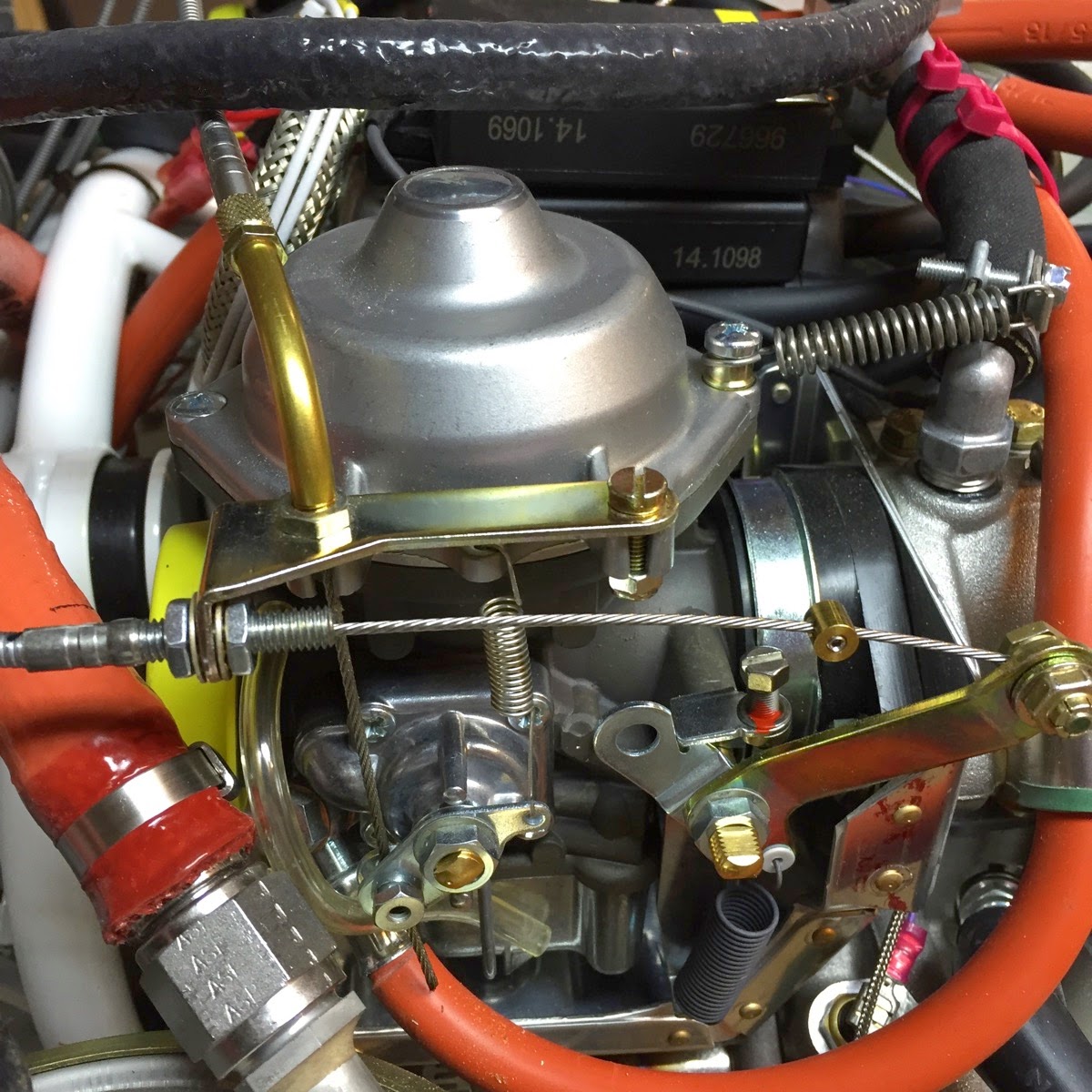
And this picture shows the left carb with its choke cable connected.  The interesting tidbit about the cable connections was the final trimming.  A pair of diagonal cutters was totally worthless.  I went back to my recently-nominated-as-favorite tool—the dremel, this time armed with the cutting disk.  The resulting shower of sparks told me that I had been attempting to cut steel wires.  The Book offers the option of heat shrinking or soldering the ends to prevent fraying.  My 30 W soldering pencil wasn’t up to the task of heating, so I have a 70 W gun in the garage and will try it again later.

IMG 4176

Choke Cable

50-05 throttle cable attach

here we see the right carb with its throttle cable attached.  I have also replaced the throttle springs with the replacements sent directly by Van’s, in lieu of the ones packaged with the cable, which in turn were supposed to be in lieu of the ones from the factory.


IMG 4173

Throttle cable connected to Carb

50-02 Throttle & Choke controls

A little more creative problem solving here.  The factory upgraded the throttle controls and now are shipping vernier versions instead of the simpler push-pulls.  When I was preparing for this step, I experimented with then throttle and promptly discovered that it comes apart when you pull it too far.  Six oblong steel bearings fell out.  I was ready to ship the thing back to MacFarlane Aviation for re-assembly, but they reassured me it was actually easy to take care of myself and pointed me to a nice YouTube that demonstrated the process.  Wonderful!

Upon reading closely, I discovered that the vernier throttle requires a 3/4” hole, but the panel only has a 1/2” hole.  There’s room to simply drill it larger with a step drill, but that doesn’t leave room for turning the nut behind the panel to secure the throttle.  The Book has you grind a flat spot on the lock washer and turn the throttle into the fixed nut, but that will scape up the paint.  The Book then helpfully suggests that you remove the panel.  Not Going To Happen.

Instead, I made a 3/4” hole in scrap aluminum, then suspended that over a dowel (cap from the Sharpie) and traced a 3/4” hole that was tangent at the top relative to the 1/2” in the panel.  Some ginger work with a dremel drum enlarged the hole in a downward (and lateral) fashion to approximately the right size, then finished it off with a step drill.  Viola!  A properly sized hole that is far enough away from the under panel to permit ordinary installation. 


IMG 4163

Throttle & Choke controls


49-14 bonding cooling duct

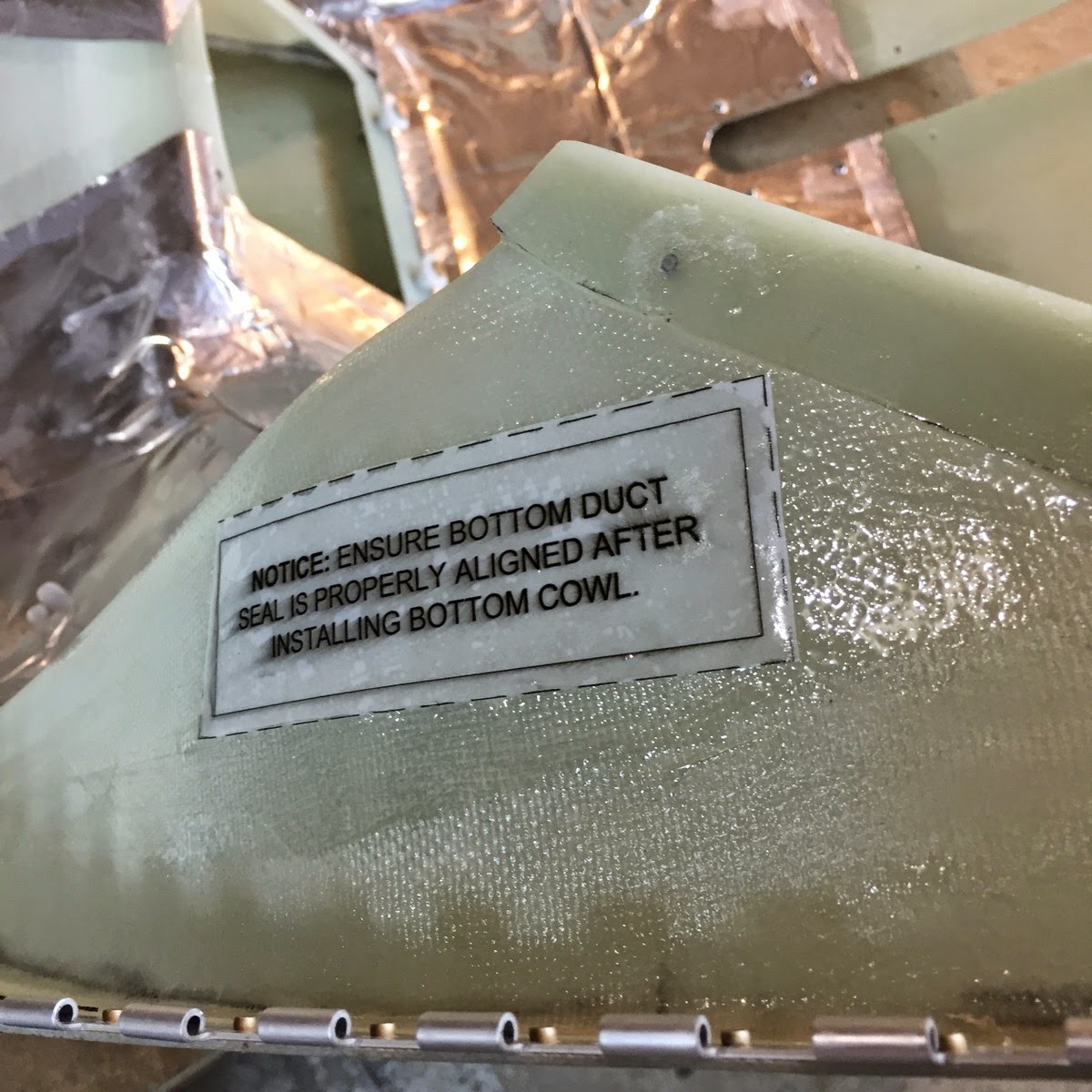
This was another new experience that I had been putting off for about a year—working with wet fiberglass.  I purchased a fiberglass “beginner’s kit” from Aircraft Spruce last year when I realized that I would need to do some epoxy work on the wing tip lights (still not done, BTW.)  I read & read & studied, and it went very well.  I didn’t get any pictures of the wet layup of the cooling duct inside the cowl because I forgot to snap them before installing the cowls on the plane while the epoxy cured.  The representative photo that you see below is looking at the duct bonded to the lower bowl’s “mouth” after I used a touch of floxed epoxy to fill in the transition.  It went really well and did not take much at all.  The Book said to use bondo if there was a small crack, but I didn’t want to go out and buy bondo when I had perfectly good floxed epoxy sitting in the freezer from the night before.


IMG 4159

Cowl to duct interface


IMG 4161

final touch!

49-16 heat shield

I’d like to make a public service announcement.  Nothing sticks to rough fiberglass, even if you rough it up first.  The thick Al foil heat shield had a pressure sensitive backing, but it just didn’t stick.  The Book has a final comment of “seal the edges” with epoxy, and mine looks like a 1st grader doing his first finger painting.  

IMG 4157

Heat Shield in place

37-09 Fuel Tank install

Continuing the thread of logic...  In order to start the engine, I need gas.  In order to get gas, I have to install the tank.  The tank can’t go in until the floor plates and back bulkhead are attached.  Unfortunately, I’ll have to take out the tank and the bulkhead when I attach the tail cone, but there’s no way to avoid that.  (Until after I get signed off, then I’ll do the bulkhead modification that will let me remove it in pieces—one piece stays in place unless the tank is removed, but the majority can be removed independently.

Since I purchased the tank pre-assembled, I didn’t have to go through the entire construction process (with all of the Pro-Seal to deal with.)  I didn’t really find a page that said “install tank”, but 37-09 seemed to have the closest instruction. 

Oh, yes.  In order to get the tank in, you have to remove the ELT, too.

Oh, and one more thing.  There’s a nut plate on the vertical rib behind the tank.  It was put on wrong side so it got drilled out and repositioned.  I’m getting better.  It didn’t take more than 10 min and I didn’t even say any bad words! ;0)

IMG 4155

installed Fuel Tank, et al.

Monday, March 30, 2015

49-17 Oil Hoses

I knew that this would be a challenge.  Those thick, heavy oil hoses don’t like to be bent or twisted.  It was a challenge getting the two from the oil reservoir down behind and under the engine.  The nipple to the bottom of the engine was just barely able to clear the muffler (and there was still oil in the bottom of the case to dribble on things and make a mess.)  Nonetheless, it’s what I expected at this stage of the game.  As more and more things get assembled, there will be less & less room to make it easy.  (After all, if it was easy, then anyone could play!)


IMG 4148

Oil Hoses


IMG 4149

Oil Cooler with Oil Hoses

By the way, the oil cooler looks distinctly crooked in this picture.  It is.  The Book tells me to attach the cowl (with installed duct assembly) and tighten the hoses with it placed thusly.  Don’t worry, I’ll get it straight before I’m done.


------------------------

Addendum:  The cowling epoxy work was done on 4/3, and I was able to finish up the last step of this page and tighten up the hoses.  I added thread seal and tightened up all 6 oil hose ends.  The cooler still hangs crooked when on its own, but it fit into the cowl OK.